
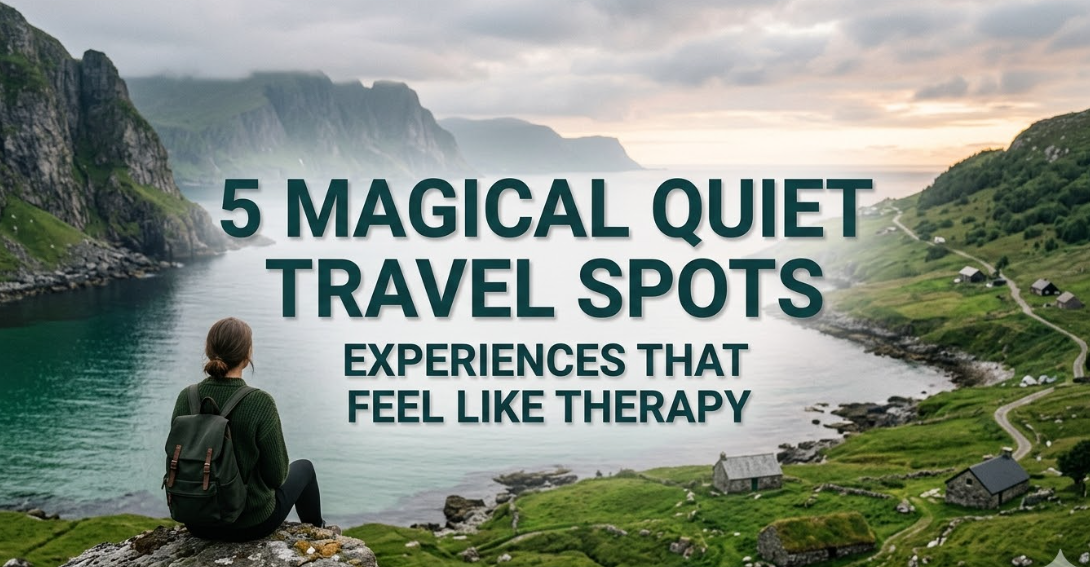
Meta Description: Quiet travel spots are healing in disguise. Discover 5 magical places that soothe your mind, body, and soul — no therapist’s couch necessary.
5 Magical Quiet Travel Spots That Will Feel Like Therapy
There’s a kind of travel that doesn’t fill your camera roll with selfies. It breathes new air into your lungs. It slows your heartbeat. It makes you feel like yourself once more.
These places exist. And they are not behind velvet ropes or long waitlists.
In a world endlessly buzzing, the most powerful thing you can do is go somewhere that doesn’t. Quiet travel spots aren’t just pretty — they are profoundly restorative. Scientists even have a name for it: nature therapy, or ecotherapy.
This article brings you five of them. Each one feels less like a vacation and more like a reset button for your entire nervous system.
Silence Is the New Self-Care
Before we look at the destinations, let’s talk about why quiet places work like therapy.
Researchers at the University of Michigan showed that time spent in nature — just 20 minutes — can reduce cortisol, the stress hormone. Another study, published in Frontiers in Psychology, found that “awe experiences” in natural settings increased feelings of meaning and decreased self-focused anxiety.
In other words: the world shrinks, and so too do your worries.
You don’t need to book a flight to a monastery in Tibet. You just need to go somewhere that mutes the noise. Here are five quiet travel spots that do just that.
1. The Faroe Islands, Denmark — Where the Wind Whispers Instead of Screams
A Place That Feels Like the Edge of the World
Nestled between Norway and Iceland, the Faroe Islands are 18 volcanic islands shrouded in green cliffs and enveloped in fog. There are about 54,000 residents there. No traffic jams. No crowded tourist streets.
Just grass-roofed houses, seabirds, and that kind of silence that wraps around you like a blanket.
The Faroes are not famous. That’s the point. No one goes there to be seen. People go to disappear — in the best sense of the phrase.
What Makes It Therapeutic
Something about the landscape here does things to your brain. There are no straight lines. No skyscrapers. No screens demanding your attention. In every direction you look, something vast and ancient stares back.
Psychologists call this “soft fascination” — when nature effortlessly holds your attention without taxing your brain. It lets your mind wander. And when minds wander in the right environment, they heal.
What to Do Here
- Walk the cliffs of Trælanípa and look down at the lake that appears to float above the ocean.
- Sit by the village of Saksun, where time genuinely feels like it has stood still.
- Visit in spring or summer for the long golden evenings, stretching into midnight.
Best Time to Visit
May through August brings wildflower meadows and long days. September is moody and cinematic — perfect for those who find beauty in mist.
2. Yakushima Island, Japan — A Forest That Breathes
The Island That Inspired a Studio Ghibli Film
Yakushima lies off the southern coast of Japan’s Kyushu island. It’s a UNESCO World Heritage site, and it looks like someone grew a forest on top of a cloud.
The cedar trees here are thousands of years old. Some have been standing since the Roman Empire was alive. The oldest, Jomon Sugi, is estimated to be between 2,170 and 7,200 years old.
Walking through this forest does not feel like a hike. It feels like being admitted somewhere sacred.
The Japanese Practice of Shinrin-Yoku
The Japanese have a word for therapeutic forest bathing: shinrin-yoku. It means absorbing the forest through your senses — breathing the air, listening to the water, touching the moss.
Research from Japanese universities has shown that shinrin-yoku lowers blood pressure, reduces stress hormones, and boosts natural killer (NK) cell activity — the cells your immune system uses to fight disease.
Yakushima is arguably one of the finest places on Earth to practice it.
What to Do Here
- Hike the Shiratani Unsuikyo Ravine trail — a moss-carpeted world that looks genuinely otherworldly.
- Camp overnight and listen to the deer and monkeys that roam freely after dark.
- Sit by the streams and do absolutely nothing. Seriously. That is the practice.
Good to Know
Rain is part of the deal here. Yakushima receives some of the heaviest rainfall in Japan. Locals say it rains 35 days a month — of which 30 are rain. Pack waterproofs and embrace the mist — it’s part of the magic.
3. Bhutan — The Country That Measures Happiness
A Kingdom That Protects Its Peace on Purpose
Bhutan is one of the most unusual countries on Earth. Its government doesn’t measure success by GDP. It measures it by Gross National Happiness.
There’s no McDonald’s. Tourism is deliberately limited. Visitors must pay a daily fee specifically designed to keep crowds small. As a result, Bhutan has remained untouched — culturally, spiritually, and environmentally — in ways that feel almost impossible in the modern world.
This is a place where monks still rise at 4 a.m. to chant. Where farmers still plant by the lunar calendar. Where the national animal is the takin — a creature so strange it looks like a cow-goat hybrid that wandered out of a dream.
The Tiger’s Nest and the Walk That Changes You
The most famous site in Bhutan is the Paro Taktsang monastery, known as Tiger’s Nest. It clings to a cliffside at 3,120 meters above sea level.
Getting there means a 4–5 hour hike through pine forests. You pass prayer flags. You hear nothing but wind and your own breath.
By the time you arrive, you’ve already had the therapy.
The hike is not about the destination. It’s about the slow, deliberate passage through a landscape so ancient and so quiet that your urban anxieties simply run out of air.
What Sets Bhutan Apart From Every Other Destination
- There are no billboards in Bhutan. Not one.
- Plastic bags are banned.
- Bhutan is carbon negative — it absorbs more carbon than it produces.
- The entire country feels like a collective agreement to stay calm.
Who Should Go
Bhutan is for people who feel spiritually depleted. Not necessarily religious people — just people who feel like they’ve lost touch with something quiet inside themselves. This place has a way of returning that to you.
4. The Azores, Portugal — Islands Made From Fire, Healed By Water
Nine Islands in the Middle of the Atlantic
The Azores archipelago sits in the middle of the Atlantic Ocean, roughly 1,500 kilometers west of Lisbon. Nine islands. Volcanic craters filled with vivid blue-green lakes. Geysers shooting steam from the earth. Hot springs bubbling up from the ocean floor.
It sounds dramatic. But the feeling of being there is anything but.
There is a concept that marine biologist Wallace J. Nichols calls the “blue mind.” He argues that being near, in, on, or under water triggers a mildly meditative state — a neurological shift that quiets the brain’s default mode network, the part responsible for rumination and self-criticism.
The Azores essentially bathes you in it.
Sete Cidades and the Two-Colored Lake
São Miguel, the largest island, contains the Sete Cidades caldera. Inside it sit two lakes — one blue, one green — divided by a narrow bridge.
Local legend says a princess and a shepherd fell in love here. Their tears filled the lakes — green for her eyes, blue for his.
Whether or not you believe the story, standing on that bridge and looking out at those two lakes, surrounded by silence and volcanic ridges, feels like something your nervous system has been waiting for.
What to Do in the Azores
- Soak in the Ferraria hot springs — natural geothermal pools where warm water meets the Atlantic.
- Hike the rim of Sete Cidades at sunrise.
- Go whale watching — the Azores is one of the best places in the world to see sperm whales.
- Eat. The food here is exceptional and unhurried. Meals are events.
Practical Notes
The Azores are accessible from Europe on budget flights, making them one of the most affordable quiet travel spots on this list. Inter-island flights are easy and cheap. English is widely spoken.
5. Luang Prabang, Laos — A Town That Teaches You to Slow Down
A UNESCO Town That Refused to Rush
Luang Prabang is a small town in northern Laos, cradled between two rivers and surrounded by forested mountains. It’s a UNESCO World Heritage town — not just for its temples, but for its entire way of life.
The streets are quiet. The pace is slow. People smile without wanting anything from you.
In the early mornings, hundreds of saffron-robed monks walk in silent procession through the streets. Residents and visitors kneel by the roadside to offer sticky rice. There’s no traffic noise. No honking. Just the soft shuffle of bare feet and the distant sound of a temple bell.
This is called the tak bat ceremony. And watching it — or better yet, participating in it — is one of the most grounding experiences a human being can have in 2025.
Why Slow Travel Is a Mental Health Tool
Travel researchers have found that slow travel — spending more time in fewer places, moving at the pace of locals — produces significantly greater mental health benefits than rapid, checklist-style tourism.
When you slow down, your brain stops scanning for threats and starts actually experiencing things. Your senses return. Your presence returns.
Luang Prabang is built for this.
What to Do Here
- Wake up for tak bat. Set your alarm for 5:30 a.m. It’s worth it every single time.
- Visit Kuang Si Falls — a series of turquoise-blue tiered waterfalls an hour from town. Swim in the lower pools. Say nothing.
- Walk along the Mekong at sunset. Buy a cold Beer Lao. Watch the river go by.
- Eat at a night market where the food costs almost nothing and tastes extraordinary.
- Rent a bicycle and cycle to villages no one has put on a map yet.
The Feeling Nobody Warns You About
Travelers to Luang Prabang often report the same unexpected emotion: grief when they leave.
Not sadness, exactly. More like waking up from a dream you didn’t want to end. The town has a way of reminding you what life feels like without urgency.
That’s the therapy.

How to Choose the Right Quiet Travel Spot for You
Not every quiet place hits the same way. Your nervous system has preferences.
| If you feel… | Go to… | Because… |
|---|---|---|
| Spiritually empty | Bhutan | Ancient monasteries, no billboards, deliberate stillness built into the culture |
| Burned out at work | Yakushima | Ancient forests, shinrin-yoku that restores cognitive function |
| Anxious and overthinking | Azores | Ocean everywhere, blue mind effect kicks in within hours |
| Like you’ve lost your wonder | Faroe Islands | Landscapes so vast that awe becomes involuntary |
| Always in a rush | Luang Prabang | A town that operates at its own speed and won’t let you speed it up |
How to Make Any Quiet Travel Spot Work for You
Going somewhere quiet doesn’t automatically make it therapeutic. Here’s how to get the most out of it.
Leave the itinerary loose. Over-scheduling a quiet trip defeats the purpose. Build in days with nothing on them. That’s not wasting time — that’s the actual work.
Put your phone in airplane mode for at least two hours each day. Not the whole trip — just stretches. The urge to document everything steals the experience of having it.
Walk more than you plan to. The best moments in quiet travel spots happen when you’re not heading anywhere in particular.
Talk to locals, slowly. Not to gather information. Just to be human. Even across a language barrier, the exchange does something good.
Let yourself feel bored. Boredom is the brain’s way of clearing its cache. If you feel restless and under-stimulated on day two, that’s not a problem — that’s the detox.
FAQs About Quiet Travel Spots
Q: Are these quiet travel spots expensive to visit?
Not necessarily. The Azores and Luang Prabang are both budget-friendly. The Faroe Islands and Yakushima are moderately priced. Bhutan is the most expensive due to its government-mandated daily tourism fee, but that fee includes accommodation, meals, and a guide.
Q: Are these destinations safe for solo travelers?
All five destinations are considered very safe for solo travelers, including solo women. Bhutan requires you to travel with a licensed guide, which adds an extra layer of security. Luang Prabang and the Azores are particularly solo-friendly.
Q: How long should I stay to actually feel the benefits?
Nature therapy researchers indicate that meaningful mental health benefits begin to appear after 3–4 days. A week is ideal. Two weeks, and you might come home a different person.
Q: What if I can’t travel far — are there quiet travel spots closer to home?
Yes. The principle matters more than the place. A cabin in the mountains two hours from your city can work just as well as Bhutan if you approach it with the same intentionality. Turn off notifications. Slow down. Let nature do its job.
Q: Is this the same as a wellness retreat?
Not exactly. Wellness retreats are structured and often expensive. Quiet travel is more organic. You’re not following a program — you’re following your own instincts in a place that doesn’t rush you. Some people find that more effective.
Q: Can I bring my kids to these quiet travel spots?
Yes, with some considerations. Yakushima and the Azores are particularly family-friendly. Bhutan’s hiking is demanding for young children but not impossible. Luang Prabang’s morning ceremonies are a beautiful cultural experience for children of any age.
The Quiet You Didn’t Know You Were Looking For
There’s a version of travel that looks like consumption — collecting stamps, checking boxes, posting content. And then there’s the kind that looks like recovery.
These five quiet travel spots belong firmly in the second category. They don’t give you adrenaline. They give you back yourself.
The Faroe Islands will make you feel small in the best possible way. Yakushima will remind you that you are part of something ancient and alive. Bhutan will show you that an entire country can choose happiness. The Azores will wash your brain clean with ocean. Luang Prabang will teach you that the world is patient, even when you’re not.
You don’t have to be unwell to need this kind of travel. You just have to be human.
Book the trip. Leave the agenda. Let the silence work.
Have you visited any of these places? Which one calls to you most? The conversation is worth having — because quiet travel is still travel, and it begins with a choice.