
Meta Description: Quiet travel spots guides you to slow down and explore the world peacefully. Here are 11 mindful destinations that provide solace, inspire joy, and genuinely encourage.
11 Quiet Travel Spot Guides That Help You Travel Mindfully
Do you return from a vacation more exhausted than before?
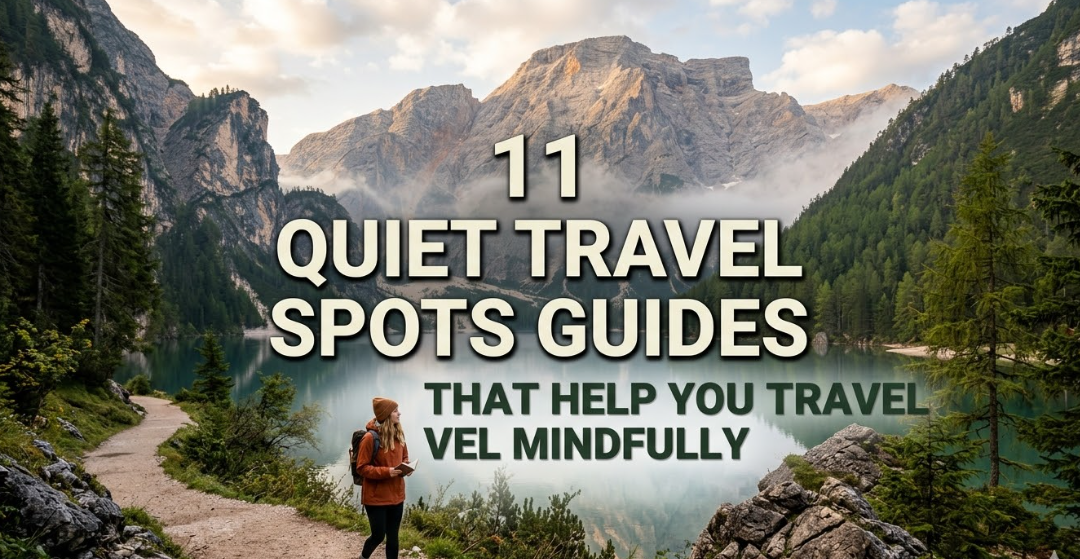
You’re not alone. Busy airports, long queues, loud hotels, and crowded points of interest can take a lot out of you. And that’s precisely why an increasing number of travelers are heading to quiet travel destinations — places where you can simply breathe, think, and be present.
Mindful travel doesn’t mean doing less. It’s about having more: more peace, more connectivity, and making your steps in life mean something.
This guide takes you to the 11 most beautiful, less-traveled quiet places around the world. Each is accompanied by advice on traveling mindfully, so your journey nourishes your soul rather than depletes it.
What Is Mindful Travel, Actually?
But before we get into the destinations, let’s clear this up.
Traveling mindfully is traveling fully immersed in your trip. This is about noticing the small stuff — the smell of fresh bread in a local bakery, the sound of wind through pine trees, the warmth of sunlight on cobblestones.
It’s the opposite of checking off a list of tourist attractions.
Here’s a straightforward way to think about it:
| Regular Travel | Mindful Travel |
|---|---|
| Crowded sites | Off-the-beaten-path locations |
| Jam-packed agenda | Flexible, lazy timeline |
| Social media-based | Present moment-based |
| Tourist traps | Community-oriented places |
| Overwhelming and draining | Slow and restorative |
Now, let’s explore the destinations.
1. The Faroe Islands, Denmark — Where the Sky Touches Water
There are few places on Earth that feel as unspoiled as the Faroe Islands.
Nestled between Norway and Iceland in the North Atlantic, this cluster of 18 islands is lined with dramatic cliffs, thundering waterfalls, and tiny fishing towns that feel straight out of a fairy tale.
There are no big tourist crowds here. No flashy resorts. Just pure, untamed nature in every direction.
Why It’s Ideal for Mindful Travel
The Faroes slow you down, naturally. Roads are narrow, towns are small, and the weather can change from one hour to another — you just have to be on-site.
Hiking to the village of Saksun, observing puffins nesting along high cliffs, or sitting by Sørvágsvatn’s infinite-pool lake will quietly awe you.
Best time to visit: June to August for longer days.
Mindful travel tip: On at least one hike, leave your phone behind. Allow yourself to get a little lost in the landscape.
2. Luang Prabang, Laos — A City That Inhales and Exhales
Laos is one of the more neglected gems of Southeast Asia, and Luang Prabang is its crown jewel.
This quaint town is bounded by the confluence of the Mekong and Nam Khan rivers. It’s a UNESCO World Heritage Site teeming with golden temples, serene monks, and verdant hills.
Life here has its own rhythm. That’s the whole point.
The Morning Alms Ritual
At dawn each day, hundreds of saffron-robed monks walk in silence through the streets to collect food offerings from local residents. Watching — or partaking in — this ancient custom is one of the most grounding things you can do as a traveler.
It serves as a reminder that simplicity and ritual can be profoundly meaningful.
Best time to visit: November to February, when the weather is cool and dry.
Mindful travel tip: Get up early. The most tranquil, ethereal moments here unfold before 8 a.m.
3. The Azores, Portugal — Europe’s Secret Volcanic Paradise
Most people haven’t even heard of the Azores.
That’s part of why they are so special.
This Portuguese archipelago is located in the central North Atlantic Ocean, approximately 1,500 kilometers off the coast of mainland Portugal. It’s a land of volcanic lakes, steaming hot springs, whale watching, and some of the greenest landscapes in Europe.
Why Travelers Find Peace Here
There aren’t any giant resort chains. No theme parks. No traffic jams.
The crater lakes on the main island, São Miguel, glimmer blue and green under changing light. At Termas da Ferraria, you can soak in geothermal hot springs as the waves crash around you.
This is nature doing the healing for you.
Best time to visit: April to October.
Mindful travel tip: At dusk, sit with no agenda by Lagoa das Sete Cidades. Let the colors do the talking.

4. Bhutan — A Kingdom That Quantifies Happiness
Bhutan does not use GDP to measure its success. It measures it in terms of Gross National Happiness.
That gives you all the information you need about this Himalayan kingdom.
Tourism here is intentionally limited. Visitors are charged a daily fee, which supports conservation and cultural preservation. That translates to fewer crowds, deeper experiences, and a nation that truly wishes you to leave enriched.
Tiger’s Nest and the Strength of Moving Slowly
This cliffside monastery, known as Paro Taktsang — or Tiger’s Nest — sits 3,000 meters above sea level. A two-hour hike gets you there.
But for most visitors, the climb is the experience. With every step up, you get a different view. Every rest stop invites reflection.
Best time to visit: March to May or September to November.
Mindful travel tip: Take your time on the hike to Tiger’s Nest. Better yet, sit at the tea house halfway up and stay for at least 20 minutes. That perspective deserves your full attention.
5. Fiordland, New Zealand — Silence You Can Almost Reach Out and Touch
Fiordland is located in the southwestern corner of New Zealand’s South Island. It is one of the wettest, most remote places on Earth — and also one of the loveliest.
Milford Sound, the crown jewel of Fiordland, is a fjord sculpted by ancient glaciers. Waterfalls cascade from mountaintops that vanish into low-lying clouds. Dolphins and penguins swim in what are almost eerily calm waters.
Why Solitude Feels Different Here
There are absolutely no traffic jams in Fiordland. No shopping malls. Just you, the water, and an overwhelming sense of how small you are — in the best possible way.
Kayaking through the fjords of Milford Sound at dawn is a priority rearranger.
Best time to visit: October to April.
Mindful travel tip: Spend the night on a cruise vessel in the sound. Nothing can describe awakening among those cliffs in the first light of dawn.
6. Puglia, Italy — The Slow Life in the Deep South
Most visitors go to Rome, Florence, or the Amalfi Coast. But Puglia — the heel of the Italian Peninsula — has something those places don’t: a real quiet.
This region of whitewashed towns, ancient olive groves, and rugged coastline has remained largely untouched for centuries. The people here are friendly, the food is remarkable, and the pace of life feels meditative.
The Magic of Trulli Villages
Alberobello is a UNESCO-designated town filled with trulli — ancient circular stone houses topped by conical roofs. Strolling its narrow streets is like stepping back in time.
Nearby Ostuni, which stands on a hilltop and is painted entirely white, glows golden at sunset in a way that literally stops you mid-step.
Best time to visit: May, June, or September.
Mindful travel tip: Rent a car and drive the backroads between towns. Stop whenever something catches your eye. The best moments in Puglia aren’t on any map.
7. Banff, Canada — Forest Bathing in the Rockies
Canada’s Banff National Park is among the most photographed locations on Earth. But get just slightly off the main trail and you can stumble on pockets of refined, untouched wilderness.
The Canadian Rockies make human problems seem very small.
Turquoise Lakes and Wooden Docks
Lake Louise and Moraine Lake are known for their impossible turquoise color — due to glacial rock flour suspended in the water. Lounging on the wooden docks at either lake in the morning hours, before the tour buses arrive, is deeply soothing.
There are also hundreds of lesser-known trails where you won’t see another human for hours.
Best time to visit: June to September for hiking; December to February for snowy peace.
Mindful travel tip: Arrive at Moraine Lake before 7 a.m. to avoid the crowds and commune with the silence. It’s worth the early alarm.
8. Oaxaca, Mexico — A Feast for All the Senses
Oaxaca is located in southern Mexico, unlike any other place in the country.
It’s a destination where ancient Zapotec culture rubs elbows with colorful street art and world-class cuisine. This is a slow-moving city, and the mountains and valleys nearby are filled with small indigenous villages, weavers, potters, and mezcal makers.
Mindful Travel Through Culture
Mindful travel isn’t only about nature — it’s also about people.
In Oaxaca, you can spend an afternoon being taught how to make tortillas with a local family, hike to Hierve el Agua’s petrified waterfall, or sit in the zócalo (town square) and watch as life unfolds around you.
The Day of the Dead celebrations here are among the most meaningful in the world.
Best time to visit: October to December.
Mindful travel tip: Engage locals in conversation, even if your Spanish is minimal. Connection is what being here is all about.
9. Palawan, Philippines — The Last Frontier
Palawan, consistently ranked as one of the world’s most beautiful islands, is no exception.
It stretches into the South China Sea with turquoise lagoons, hidden beaches, limestone cliffs, and some of the most diverse coral reefs on Earth. El Nido’s main town is small and laid-back.
Island Hopping Without the Rush
The trick to Palawan is to go slow. Forget the crowded island-hopping tours and hire a private bangka (wooden boat) for the day. Pull in at whichever beach tempts you. Snorkel with no agenda.
The waters here are warm, clear, and teeming with life. It is the kind of place that makes you lose track of what day it is.
Best time to visit: December to May.
Mindful travel tip: Instead of resorts, book accommodation in small, locally owned guesthouses. It’s the personal connection that makes everything more vivid.

10. Madeira, Portugal — The Floating Garden of the Atlantic
Madeira is a Portuguese island about 1,000 kilometers southwest of Lisbon, and it’s one of Europe’s most underrated destinations.
Picture a volcanic island dense with tropical flowers, intersected by centuries-old irrigation channels known as levadas, and edged by roaring sea cliffs diving into the Atlantic on all sides.
Walking the Levadas
It is the levada walks that make Madeira truly special for those who travel mindfully. According to UNESCO’s heritage travel resources, slow nature-based routes like levada trails are among the most restorative travel experiences in the world.
These narrow routes skirt centuries-old watercourses that once supplied the island’s farms. Some are flat and simple; others are carved into cliff faces, with sheer drops on one side and dripping rock walls on the other.
All of them take you deep into a green, quiet world that seems totally separate from modern life.
Best time to visit: Year-round, but spring is magical when flowers bloom.
Mindful travel tip: Walk a levada solo if it feels right for you. The lack of chatter makes you aware of everything — the birdsong, the bubbling water, the lingering scent of eucalyptus.
11. Patagonia, Argentina & Chile — The End of the World, Beautifully
Patagonia is among the last of Earth’s great wildernesses.
Shared by Argentina and Chile, this remote region at the southern tip of South America is home to glaciers, towering mountain peaks, turquoise lakes, and Pampas grasslands stretching to the horizon. The iconic Torres del Paine National Park in Chile is a world apart.
Why This Place Changes People
Patagonia has earned a reputation for transforming travelers.
Something about its enormous scale — the sky bigger than you’ve ever seen it, the wind louder than in any city — strips away a lot of the noise of daily life. People arrive here anxious and leave with an odd sense of clarity.
The five-day W Trek in Torres del Paine is one of the great hikes in the world. It’s challenging, remote, and deeply beautiful.
Best time to visit: November to March (Southern Hemisphere summer).
Mindful travel tip: Take your time on the W Trek. Build in an extra day. The weather will change, and you’ll want the flexibility to sit with it when it does.
How to Actually Travel Mindfully — Wherever You’re Going
Choosing a quiet destination is a good first step. But mindful travel is also a collection of habits you take with you.
Here are a few simple practices that work anywhere:
Don’t Check Your Phone First Thing
Give yourself the first 30 minutes of each morning to simply be where you are. Look out the window. Drink your coffee slowly. Notice what the light is doing.
That one habit transforms the entire tone of a travel day.
Use a Travel Journal
When you write down what you notice — not just what you did — it sharpens your attention. It also offers you something far more precious than pictures: a record of how you felt in a place.
Eat Where Locals Eat
Avoid the gravitational pull of tourist menus and familiar chains. Local cuisine tells you more about a place than any museum. Ask your host, your driver, or a stranger on the street where they eat. Then go there.
Limit Daily Destinations
The biggest trap in travel is trying to see too much. Choose one or two things each day. Focus fully on each one. You will remember them much more clearly.
Spend Time Doing Nothing
This one is uncomfortable for many of us. Sitting in a park. Watching a river. Drinking tea in a square with no plan.
That stillness is not time wasted. It’s often where the best travel memories are made.
A Mindful Travel Checklist Before You Go
| Before You Travel | During Your Trip | When You Return |
|---|---|---|
| Research local customs | Keep a daily journal | Reflect on one key memory |
| Book small local stays | Eat at local spots | Share stories, not just photos |
| Pack light | Spend time offline every day | Plan your next slow trip |
| Learn a few local phrases | Walk instead of taking taxis | Practice gratitude for what you experienced |
| Set a flexible itinerary | Say yes to conversations | Write down what changed in you |
FAQs About Quiet Travel Spots
Q: What does “quiet” mean when it comes to a travel destination? A quiet travel destination is a location not overrun by mass tourism. It is generally less crowded, more laid-back, has a stronger local culture, and offers more chances for authentic experiences in either nature or community.
Q: Is a faraway destination the only way to find solitude? Not at all. Quiet places can be just a few hours outside big cities. Think of small mountain towns, coastal villages, rural valleys, or even urban neighborhoods that most tourists leave off their itineraries. Mindful travel is as much about attitude as it is about destination.
Q: Is mindful travel just for experienced travelers? No. In fact, it’s an excellent approach for first-time solo travelers: it gives you permission to go slow, ask for help, and leave yourself open to unexpected experiences. You don’t need a packed itinerary to have a meaningful trip.
Q: How can I seek out quieter areas in popular destinations? The trick is to visit either early (before 8 a.m.) or late (after 5 p.m.), or just slightly off the main route. Most famous sites have a quieter version of themselves if you’re willing to seek it out.
Q: Can families travel mindfully? Absolutely. Children often thrive during slow, quiet travel. They notice things that adults hurry past. Let them participate in choosing one activity per day, and allow them to lead sometimes.
Q: What should I pack for a mindful journey? Pack light, pack natural. A journal, a good book, a reusable water bottle, comfortable walking shoes, and an open mind. Leave the over-scheduled itinerary at home.
Q: Are quieter travel spots less safe? Not inherently. Many low-key travel destinations are actually more secure than busy tourist hotspots because there are fewer scams and less petty crime. Always research local safety conditions before heading out, but don’t assume remote means unsafe.
Conclusion — The World Is Quieter Than You Think
There is a kind of travel that makes you feel truly rested.
It doesn’t take first-class flights or five-star hotels. It takes presence, curiosity, and slowing down enough to truly see the places you visit.
The 11 quiet travel spots in this guide — from the volcanic lakes of the Azores to the wind-blown plains of Patagonia — share one thing in common. They reward the traveler who arrives without a checklist and lingers long enough for the place to settle in.
The world is more subdued than the tourist brochures would lead you to believe. You just need to know where — and how — to look.
Start planning your next trip with purpose. Choose one destination from this list. Book a small, local guesthouse. Leave two full days unplanned.
Then see what happens.
Liked this guide? Read more about mindful travel, slow travel, and off-the-beaten-path destinations to continue building your quiet travel practice.