
Meta Description: Terrific places for silent tourism or travel spots if you love nature and prefer to be away from the noise of tourists crowded in one location — hidden gems where silence, beauty, and wilderness can bring out the best in you.
Nothing But Nature: 10 Quiet Travel Destinations & Experiences
Escape the Noise — Why Quiet Travel Is the New Luxury
The world moves fast. Cities are louder than ever. Booming tourist hotspots much resemble theme parks than tranquil getaways.
That’s why an increasing number of nature lovers are opting for a different type of trip. No huge crowds. No Instagram lines. Just unadulterated, beautiful nature — and silence.
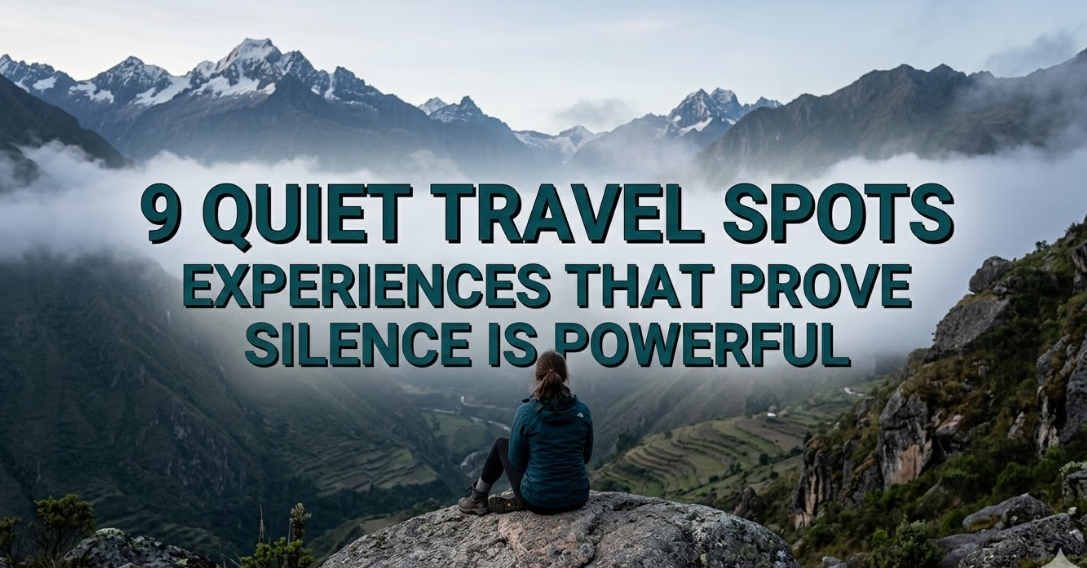
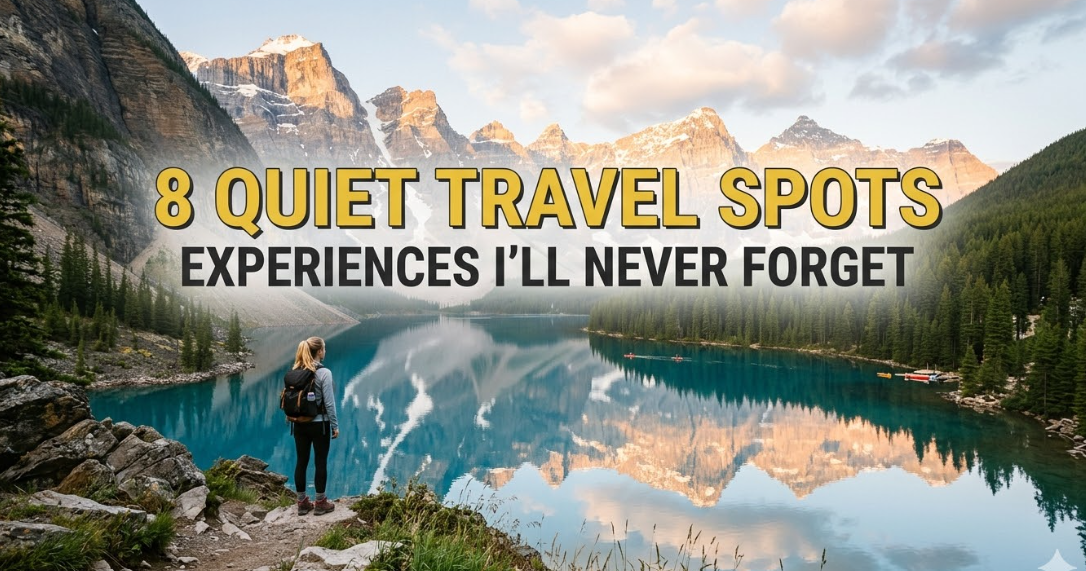
Quiet travel is not about visiting somewhere dull. It’s about going somewhere real. A foggy mountain trail in the early morning. A lake that’s as tranquil as glass. A forest trail of solitude, save for your own footsteps.
These experiences don’t have to break the bank. They just need to be chosen wisely.
This article covers 10 of the most magnificent quiet travel spots in the world. All are great for nature lovers looking to slow down, take a deep breath, and really feel something.
So, if you’re looking for a getaway — whether it’s solo, as a couple, or with the family away from all that madness — this list has something for you.
What Is a (Really) “Quiet” Travel Spot?
Before we dig in, here’s a simple table that compares and contrasts quiet travel spots with standard tourist destinations:
| Feature | Typical Tourist Spot | Quiet Nature Spot |
|---|---|---|
| Crowd Size | Very high | Low to moderate |
| Noise Level | High | Minimal |
| Wildlife Presence | Rare | Common |
| Instagram Fame | Viral | Mostly unknown |
| Local Impact | Often over-touristed | Sustainable |
| Best For | Sightseeing | Healing, exploring |
| Booking Difficulty | Hard in peak season | Usually easy |
Without further ado, let us dive into the list.
1. The Faroe Islands, Denmark — A Place That Feels Like a Dream
Where the Atlantic Meets Silence
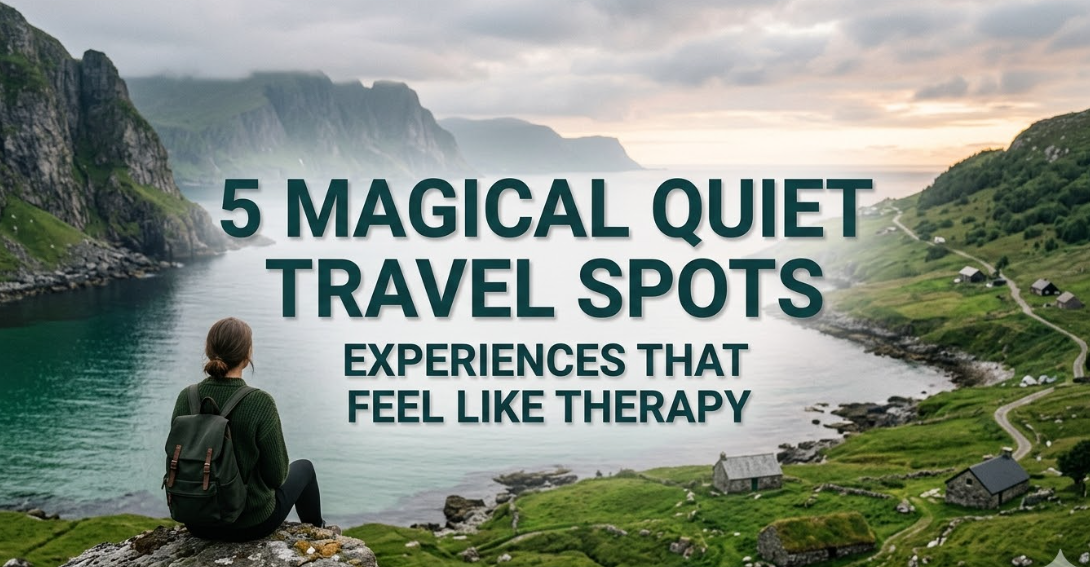
Sitting between Norway and Iceland, the Faroe Islands consist of 18 small islands covered in towering cliffs, verdant valleys, and waterfalls that plummet directly into the sea.
Very few people have ever heard of them. That is exactly the point.
The islands have fewer than 55,000 inhabitants. Tourists are welcome, but the islands are not inundated. You can walk for hours and cover a dozen miles to see nothing except sheep, grass, and ocean.
The most beautiful trail is the hike to Sørvágsvatn Lake — a lake that seems perched above the ocean owing to an optical illusion. The view is unlike anything else on earth.
Best time to travel: May–September Good for: Hiking, bird watching, coastal walks Hidden gem: The mountain village of Gásadalur, which can only be reached via a narrow path through the mountains
What You Will Find Here
- Sea cliffs tumbling down hundreds of meters
- A colony of puffins along the rocks
- Little grass-roofed villages with no traffic lights
- Total digital disconnection if you wish
2. Jiuzhaigou Valley, China — Colors That Don’t Seem Real
A Valley Painted in Colors You Have Never Seen
Jiuzhaigou Valley is a UNESCO World Heritage Site in the Sichuan province of China that few Western travelers have ever seen.
The water here is not normal. It’s turquoise, emerald, and deep blue all at the same time — tinted by minerals and lake beds strewn with ancient coral. In autumn, the trees surrounding it turn gold and red in a contrast that looks almost digital.
The valley is dotted with more than 100 lakes, linked by waterfalls and forest trails. You can spend days walking between them.
Following a severe earthquake in 2017, the park restricted visits. This actually helped restore its inherent beauty and drove crowds way down.
Best time to visit: September through November for fall foliage; April through June for spring green Good for: Photography, walking, nature study Pro tip: Reserve a ticket weeks in advance — daily visitor limits are strictly enforced
Why Nature Lovers Choose Jiuzhaigou
The only sound is waterfalls. No motorboats are allowed on the lakes. No loud music. Only the sound of running water and wind through pine trees.
3. Plitvice Lakes, Croatia — A Walk Through a Fairytale
Sixteen Lakes, One Magical Ecosystem
You might say that the most beautiful quiet travel destination in Europe is Croatia’s Plitvice Lakes National Park — and yet most travelers ignore it for Dubrovnik’s packed old city.
The park includes 16 terraced lakes linked by waterfalls and wooden boardwalks. The color of the water shifts with the sun. One hour it is green. The next hour it is dark azure.
You walk on floating wooden walkways, above the water, with fish visibly swimming underfoot. Deer wander into clearings. Butterflies are everywhere in summer.
Best time to go: April–June or September–October Ideal for: Family walks, wildlife spotting, photography Avoid: July and August are the busiest months
The Numbers Behind Plitvice
| Characteristic | Detail |
|---|---|
| Total Area | 296.85 km² |
| Number of Lakes | 16 |
| Largest Waterfall | Veliki Slap — 78 m |
| UNESCO Status | Since 1979 |
| Trail Recommendation | Route H — full day, 18 km |
4. Whanganui National Park, New Zealand — A River With Rights
The First River on Earth to Be a Living Entity
New Zealand is filled with quiet, spectacular natural beauty. But Whanganui is unusual even by New Zealand standards.
In 2017, the Whanganui River was granted legal personhood — the same legal rights as a human being — making it the first river in the world to achieve that status. To the Māori people, the river has long been a living ancestor.
The national park surrounding it is thick with ancient forest. Much of it can be traversed only by canoe, on the river itself.
This is not a place you hurry through. You paddle slowly. You camp on the riverbank. You watch the fog drift up from the valley at dawn. Except for the river, you hear nothing.
Best time to visit: November to April Good for: Canoe expeditions, multi-day camping, cultural history Key experience: The “Journey on the Whanganui” — a 5-day canoe expedition through untamed forest
What Makes This Spot Unique
- Difficult to reach by road and remote
- Deep cultural significance to Māori people
- No developed towns inside the park
- True wilderness, minimal facilities
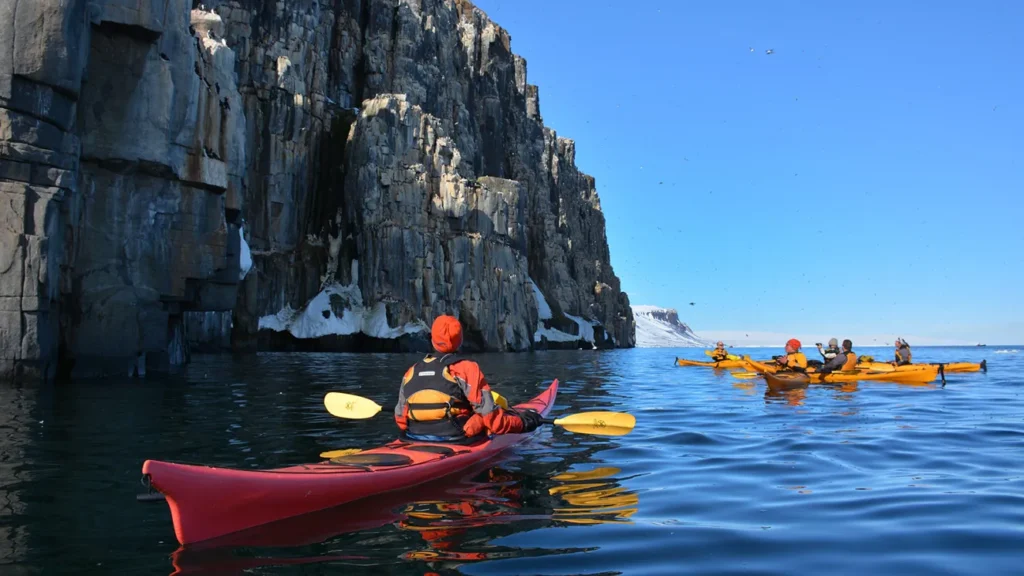
5. Svalbard, Norway — Where Nature Is Still in Control
A Place Where Polar Bears Outnumber People
Svalbard is a Norwegian archipelago about halfway between mainland Norway and the North Pole. It is among the most northernmost inhabited places on earth.
Here, polar bears outnumber people. The terrain is all glaciers, arctic tundra, and sea ice. In summer, the sun never sets. In winter, it never rises.
For extreme nature lovers, it’s the ultimate quiet travel destination. Roads do not connect settlements. It is only accessible by snowmobiles and boats.
Best time to go: March through May for dog sledding and northern lights; June through August for the midnight sun Good for: Arctic wildlife, glacier hiking, extreme solitude Unusual fact: You must carry a rifle outside the main settlement to protect against polar bears
Svalbard vs. Iceland — A Brief Comparison
| Factor | Svalbard | Iceland |
|---|---|---|
| Crowd Level | Very low | Moderate to high |
| Wildlife | Polar bears, walrus | Puffins, reindeer |
| Access | Flights from Oslo | Flights from many cities |
| Best Season | Spring or summer | Year-round |
| Unique Feature | Midnight sun, polar bears | Northern lights, geysers |
6. Socotra Island, Yemen — The Alien Forest of the Indian Ocean
Plants That Seem to Be From Another Planet
Socotra Island is in the Arabian Sea, off the coast of Yemen. It has been cut off from the rest of the world for millions of years. That isolation created something extraordinary.
About a third of Socotra’s plants are found nowhere else on the planet. The most famous is the Dragon Blood Tree — a tree with a flat, umbrella-shaped canopy and deep red sap. Strolling through a grove of them is like arriving on another planet.
Access is by charter flights only, and despite the politically charged atmosphere in Yemen itself, Socotra is relatively safe and welcoming to visitors.
Best time to visit: October–April Good for: Botany, bird watching, unique photography Key highlight: Dragon Blood Tree groves on the Dixam Plateau
Socotra Fast Facts
- Over 700 endemic plant species
- 37% of plant life found nowhere else on earth
- UNESCO World Heritage Site since 2008
- Fewer than 5,000 tourists visit each year
7. Kogelberg Biosphere Reserve, South Africa — Fynbos & Total Freedom
Africa’s Most Biodiverse Coastal Nature Reserve
The majority of visitors flock to South Africa for safari. Very few find Kogelberg — a biosphere reserve approximately 90 minutes from Cape Town.
Kogelberg is the center of the Cape Floral Kingdom, one of six plant kingdoms in the world and the only one entirely within a single country.
The fynbos — a shrubland that exists nowhere else in the world — bursts into vibrant color from August to October. You can walk for whole days and not encounter a single human being. The coastline is rugged and wild, with no development in sight.
Best time to go: August to October for wildflower blooms Great for: Hiking, kayaking, fynbos photography Tip: Stay in Kleinmond, a small town at the reserve’s edge
8. Tusheti, Georgia — Medieval Villages in the Clouds
The Caucasus Mountains Hide a World Trapped in Time
Tusheti is a mountainous area of northeastern Georgia. To reach it, you traverse one of the world’s most perilous mountain roads — a dirt path clinging to the side of a cliff at more than 2,900 meters above sea level.
But when you get there, you discover something rare. Stone towers and medieval villages that appear frozen in time for 500 years. Grasslands stretching to the horizon. Shepherds herding their flocks from valley to valley.
Tourists rarely make it this far. The road is open from June to October only. In winter, the villages are entirely deserted.
Best season: July to September Type of trip: Trekking, cultural immersion, mountain photography Must visit: The village of Omalo and its ancient towers
Why Tusheti Feels Like Time Travel
- No paved roads inside the region
- Residents still practice ancient shepherd traditions
- No chain stores, no traffic, no noise
- Population drops to near zero in winter
9. Yakushima Island, Japan — A Forest That Inspired Studio Ghibli
Gnarled Trees and Fog-Shrouded Mountains on a Tiny Japanese Island
Yakushima is a small island located off the southern coast of Japan. This region gets a lot of rain — sometimes more than 4,000 mm annually. That rainfall nourishes one of Japan’s most ancient forests.
The cedar trees here have been growing for thousands of years. Some date back over 7,000 years. The oldest, Jōmon Sugi, is so big that it takes 16 adults holding hands to circle its girth.
The forest is dark, mossy, and deeply atmospheric. It is said to have directly inspired Studio Ghibli’s forest scenes in Princess Mononoke.
Best time to visit: March–May or September–November Good for: Forest bathing, wildlife, ancient tree trekking Must do: The overnight hike to Jōmon Sugi — a 22 km round trip through pure ancient forest
Yakushima at a Glance
| Category | Detail |
|---|---|
| Island Area | 504 km² |
| UNESCO Recognition | Since 1993 |
| Oldest Tree | Jōmon Sugi — ~7,200 years |
| Annual Rainfall | Up to 10,000 mm in the mountains |
| Wildlife | Yakushima macaques, sika deer |
10. Lençóis Maranhenses, Brazil — A Desert That Fills With Water
The Landscape That Defies Every Rule
Most deserts are dry. Lençóis Maranhenses is not.
At first glance, this national park in northeastern Brazil resembles a desert — huge white sand dunes extending to the horizon. Yet from June to September, seasonal rains turn the valleys between the dunes into crystal-clear freshwater lagoons.
The outcome is one of the most surreal terrains on Earth. You stroll over white sand and suddenly look down into a turquoise or emerald lagoon fed by rainwater. Fish materialize in the water, as if from nowhere.
Best time to go: June–September for lagoons at their fullest Good for: Photography, swimming, surreal landscape walking Key lagoons: Lagoa Azul and Lagoa Bonita are the prettiest
Lençóis Maranhenses vs. Other Famous Deserts
| Desert | Country | Unique Feature | Crowds |
|---|---|---|---|
| Lençóis Maranhenses | Brazil | Freshwater lagoons in dunes | Very low |
| Sahara | Africa | World’s largest hot desert | Moderate |
| Atacama | Chile | Driest place on earth | Moderate |
| White Sands | USA | Gypsum sand dunes | Moderate to high |
Pro Tips — What to Know Before You Go on a Quiet Nature Trip
How to Find Quiet Travel Spots Without Losing Your Way
Not all of the best quiet travel spots are on page one of Google. Here are some ideas for finding them:
- Consult local tourism boards — they tend to promote lesser-known areas
- Check out UNESCO Biosphere Reserves — many are gorgeous and under-visited
- Follow and connect with long-distance hiking trail communities — walkers discover remote beauty first
- Look for national parks in smaller or lesser-known countries
- Skip school holidays in your home country — most crowds follow the same schedule
If you want a curated head start, Quiet Travel Spots is a brilliant resource dedicated entirely to helping nature lovers find peaceful, off-the-beaten-path destinations around the world.
Responsible Travel in Fragile Places
Quiet beaches, prairies, and meadows only stay quiet when visitors watch out for them. Here are some basic guidelines to consider:
- Stay on marked trails — off-trail damage takes decades to heal
- Take out everything that you brought in
- Never feed wildlife — it throws off natural behavior
- Respect local communities and cultural practices
- Choose independent, family-run guesthouses instead of major resort chains
Infographic: 10 Quiet Travel Spots at a Glance
| # | Destination | Country | Best Time to Visit | Key Feature |
|---|---|---|---|---|
| 1 | Faroe Islands | Denmark | May–Sep | Sea cliffs, optical illusion lake |
| 2 | Jiuzhaigou Valley | China | Sep–Nov | Multicolored mineral lakes |
| 3 | Plitvice Lakes | Croatia | Apr–Jun | Boardwalks over terraced lakes |
| 4 | Whanganui NP | New Zealand | Nov–Apr | River canoe journey |
| 5 | Svalbard | Norway | Mar–Aug | Arctic wilderness, polar bears |
| 6 | Socotra Island | Yemen | Oct–Apr | Dragon Blood Trees |
| 7 | Kogelberg Reserve | South Africa | Aug–Oct | Fynbos wildflower kingdom |
| 8 | Tusheti | Georgia | Jul–Sep | Medieval mountain villages |
| 9 | Yakushima Island | Japan | Mar–May | Ancient cedar forest |
| 10 | Lençóis Maranhenses | Brazil | Jun–Sep | Freshwater lagoons in dunes |
Frequently Asked Questions About Quiet Travel Spots for Nature Lovers
Q1: What do you mean by quiet travel spots? Quiet travel spots are places where tourist foot traffic is minimal, surrounded by nature with a calming vibe. They are places where nature can be enjoyed without noise, crowds, or heavy commercialization.
Q2: Are off-the-beaten-path nature destinations safe for solo travelers? Most peaceful nature locations are very safe for solo travelers. But certain remote spots — Svalbard or Tusheti, say — demand more preparation, a local guide, and/or special gear. Always do your homework on the specific destination before you go.
Q3: Are quiet travel places cheaper than popular tourist sites? Often, yes. Peaceful places tend to have lower lodging prices, fewer entry fees, and less demand-driven pricing. Remote locations can, however, necessitate costly transportation to reach them.
Q4: Where is a good starting point for quiet travel? Croatia’s Plitvice Lakes and China’s Jiuzhaigou Valley are great for first-time nature travelers. They boast excellent trails, visitor infrastructure, and stunning scenery — all without the need for extreme physical fitness or gear.
Q5: Do these quiet nature places work for families with children? Yes. Places like Plitvice Lakes, Yakushima Island, and Lençóis Maranhenses are extremely family-friendly. Other places, like Svalbard or Tusheti, are more suitable for adults or older children with hiking experience.
Q6: How do I escape the crowds even at popular quiet places? Go in shoulder season (spring or autumn), make weekday visits instead of weekends, arrive early in the morning, and look into daily visitor cap systems, where parks limit the number of people who can enter.
Q7: What do I need to pack for a nature getaway? Essentials include a good pair of walking shoes or hiking boots, weather-appropriate layers, a reusable water bottle, a basic first aid kit, offline maps, a camera, and a journal. For backcountry areas, include a satellite communicator and emergency supplies.
The World Is Still Filled With Wild, Quiet Places
But here is something that people tend to overlook: not all beautiful places on earth have been tamed into tourism.
Millions of square kilometers of forest, coastline, mountain, and wetland are largely pristine. They are waiting for the travelers who care enough to seek them out.
These quiet travel spots on this list are more than scenic. They are reminders that the natural world remains. Still breathing. Still extraordinary — if you go a little farther out and look a little harder.
You don’t need a picture-perfect Instagram shot to have a perfect trip. All you have to do is be present, pay attention, and let the landscape work its magic.
Begin with one of the destinations on this list. Plan it carefully. Go there with curiosity and respect. The experience will linger with you much longer than any bustling city break ever can.
Happy wandering — and be kind to your fellow travelers.