

Meta Description: Like droves, these quiet travel spots in Asia allow you to slow down, recharge and escape the tourists. These 5 peaceful destinations are hidden gem getaways.
5 Best Quiet Travel Places in Asia For a Peaceful Getaway
Fed up with crowded beaches and congested tourist streets? Asia is massive. It has some of the most popular tourist destinations anywhere — but also some of its most understatedly beautiful. The good news? You don’t need to fight crowds to watch the magic of this continent.
This guide is for travelers in pursuit of something unusual. Something slower. Whether you’re burnt out, want a solo retreat, or simply crave some calm, these five quiet travel spots in Asia will serve up exactly what you need — peace, beauty, and plenty of wonder without the noise.
Let’s discuss them one by one.
Why Quiet Travel in Asia Is Having a Moment
Overtourism is a real problem. Bangkok, Bali, and Tokyo are great cities — but at peak season they can seem like too much. Queueing, markup, and crowded streets can rob any trip of its joy.
Which is why so many travelers are embracing slow travel. The concept is simple: travel to fewer places, spend more time there, go deeper.
Asia is perfect for this. It’s a realm of 48 nations, thousands of islands, ancient mountain villages, misty river valleys, and lost temple trails. Most of these places experience minimal international tourism. They’re off the radar — and that’s precisely what makes them special.
1. Luang Prabang, Laos — Where the River Speaks Louder Than the Crowd
A Town Frozen in Graceful Time
Luang Prabang lies at the confluence of the Mekong and Nam Khan rivers in northern Laos. It’s a UNESCO World Heritage town — though not the kind with loud crowds. Golden temples line the streets. Saffron-robed monks walk silently in the dawn hours. The entire town operates on a quiet, gentle rhythm that much of the modern world has lost touch with.
If you’re on the hunt for truly quiet travel spots in Asia, Luang Prabang should be high on your list.
What Makes It So Special?
The town wakes up early. Every morning, just before dawn, local monks troop out from their temples for alms-giving — a ritual called “tak bat.” Residents and a handful of respectful tourists line the streets in silence, offering sticky rice. It is profoundly moving and utterly still.
After that? The rest of the day unfolds at whatever pace you’d like.
You can rent a bike and pedal through French colonial alleyways. You can go by boat to the Pak Ou Caves, where thousands of Buddha figurines sit in the cliffside. You can ascend 328 steps to Phou Si Hill and gaze at the sun setting over river bends.
Practical Info for Visiting Luang Prabang
| Detail | Info |
|---|---|
| Best time to visit | November to February |
| Ideal trip length | 4–7 days |
| Budget range | $30–$80/day |
| Crowd level | Low to moderate |
| Must-try experience | Alms-giving at sunrise |
| Getting there | Fly via Bangkok or Hanoi |
Where to Stay for Peace and Quiet
If you’re looking for actual quiet, stay away from the backpacker strip near the night market. Instead, find small guesthouses along the Nam Khan riverfront. Most have hammocks, river views, and no TVs. That’s the point.
Luang Prabang isn’t exactly undiscovered — but it has done a good job of managing its tourism. The town really still feels like itself. That’s rare.
2. Spiti Valley, Himachal Pradesh, India — Raw, Remote, and Breathtaking
The Cold Desert That Few People Reach
Spiti Valley, located in the Indian Himalayas, sits at an average elevation of 12,500 feet. It belongs to Himachal Pradesh, wedged between the lofty peaks of Tibet and the greener valleys below. Very few international tourists make it here — and that’s precisely its gift.
The landscape is like no other in Asia. It’s a cold desert. Barren brown mountains tower over deep ravines. Turquoise rivers run through rocky plains. Ancient Buddhist monasteries cling to cliffsides, appearing to have been set there by divine intent.
Spiti is one of the most underrated quiet travel spots in Asia — perhaps on Earth.
Life at High Altitude
The villages here — Kaza, Kibber, Langza, Dhankar — are tiny and genuine. People cultivate barley and peas on small green fields amid stone and sand. Life moves slowly because the altitude demands it.
At 14,000 feet, even a short stroll will leave you gasping. You slow down even if you don’t intend to. That enforced stillness is part of the experience.
The monasteries are extraordinary. Built on a cone-shaped hill, Key Monastery dates back more than 1,000 years. Dhankar Monastery sits above a dramatic river confluence. Tabo Monastery — dubbed the “Ajanta of the Himalayas” — holds ancient murals and sculptures that have remained intact for centuries.
Getting There and What to Expect
Spiti is not easy to reach. That’s part of what makes it so quiet.
The two main routes are from Shimla (via Kinnaur) or from Manali (over the Rohtang and Kunzum passes). Both are mountain roads — narrow, dramatic, and sometimes impassable in winter. The Manali route is only open from roughly June to October.
This is not a destination for the comfort-seeking traveler. Accommodation is basic. Electricity can be patchy. WiFi is rare. But if you can handle that? You’ll find yourself standing in one of the most soul-stretching landscapes on Earth.
Spiti at a Glance
| Detail | Info |
|---|---|
| Best time to visit | June to October |
| Altitude | 12,500–14,800 ft |
| Ideal trip length | 7–10 days |
| Budget range | $25–$60/day |
| Must-see | Key Monastery, Chandratal Lake |
| Getting there | Drive from Manali or Shimla |
3. Kampot, Cambodia — The Sleepy River Town That Time Forgot
A Riverside Escape in Southern Cambodia
Kampot is a small provincial town on the Praek Tuek Chhu River in southern Cambodia, just an hour from the Thai border and a short drive from the sea. For years it was overlooked in favor of Siem Reap and Phnom Penh. That has shifted a bit — but not too much.
There’s a slow, dreamy quality to the town that’s hard to come across. Old French colonial buildings lean softly over tranquil streets. Locals cast lines into the river at dusk. Pepper farms climb the hillsides toward Bokor Mountain.
Kampot is one of the most underrated quiet travel spots in Asia for lovers of “doing nothing well.”
What to Do in Kampot (and What Not to Rush)
This is not a box-ticking place. It’s a space for sitting still.
That said, here’s what fills a few lovely days:
Kayaking the river. At daybreak or twilight, the river is glassy and still. Paddling past mangroves and fishing villages is one of the calmest things you can do here.
Visiting the pepper plantations. Kampot pepper is world-famous among chefs. The farms welcome visitors. You’ll stroll through rows of vines, nibble peppercorns straight off the branch, and understand why this spice has its own geographic indicator — like fine wine.
Bokor Hill Station. A winding road rises to a French colonial hill station, now a curious, misty ghost town. The views down the coast are stunning.
Eating fresh seafood. River shrimp, crab, squid — all incredibly fresh, inexpensive, and served with little fuss.
Why Kampot Feels Different
There is a French colonial legacy here that shows in the architecture — crumbling facades, high ceilings, and wide shuttered windows. The riverfront hasn’t been over-developed. For $6 a day, you can hire a motorbike and explore the surrounding countryside completely at your own pace.
Kampot draws a certain kind of traveler — writers, artists, long-term nomads, people who have stopped rushing. That energy is contagious.
4. Yakushima Island, Japan — A Forest Older Than Civilization
Japan’s Green Secret
When most people think of Japan, they picture the neon streets of Tokyo or the temple rows of Kyoto. Yakushima is something completely different. It’s a remote island off the southern tip of Kyushu — and it feels like entering a world that existed long before humans arrived.
Yakushima is home to one of Japan’s oldest forests. It inspired the Studio Ghibli film Princess Mononoke. The cedars here — known as Yakusugi — can survive for thousands of years. Some have existed since before the Roman Empire.
This is one of the truly magical quiet travel spots in Asia for nature lovers.
The Trails and the Trees
Hiking trails on the island lead deep into a forest where everything is covered in moss. The air is thick and green. Waterfalls tumble through the forest canopy. Deer stroll along the trails without fear. Wild monkeys lounge in the trees and stare as you walk by.
The most popular trail leads to Jomon Sugi — a cedar tree believed to be between 2,000 and 7,200 years old. The return hike takes approximately 10 hours. It’s not easy. But standing in front of that tree is something else entirely. There is a gravity to it — an age so vast that it rewrites your sense of time itself.
Rain, Turtles, and the Rhythm of the Island
Yakushima gets a lot of rain. Locals joke that it rains “35 days a month.” The rain is what keeps the forest so impossibly lush. Come prepared — a good waterproof jacket is essential.
From May to August, loggerhead sea turtles crawl up on Yakushima’s beaches to lay their eggs. Watching this at night — done carefully and with guides who protect the turtles — is deeply moving. According to the Japan National Tourism Organization, Yakushima’s sea turtle nesting season is one of the most remarkable wildlife experiences in the entire country.
Yakushima Travel Snapshot
| Detail | Info |
|---|---|
| Best time to visit | March to May, Sept to Nov |
| Ideal trip length | 3–5 days |
| Budget range | $80–$150/day |
| Crowd level | Very low |
| Must-do | Jomon Sugi hike |
| Getting there | Ferry from Kagoshima or short flight |
5. Bumthang Valley, Bhutan — The Spiritual Heart of the Himalayas
The Place That Asks You to Slow Down
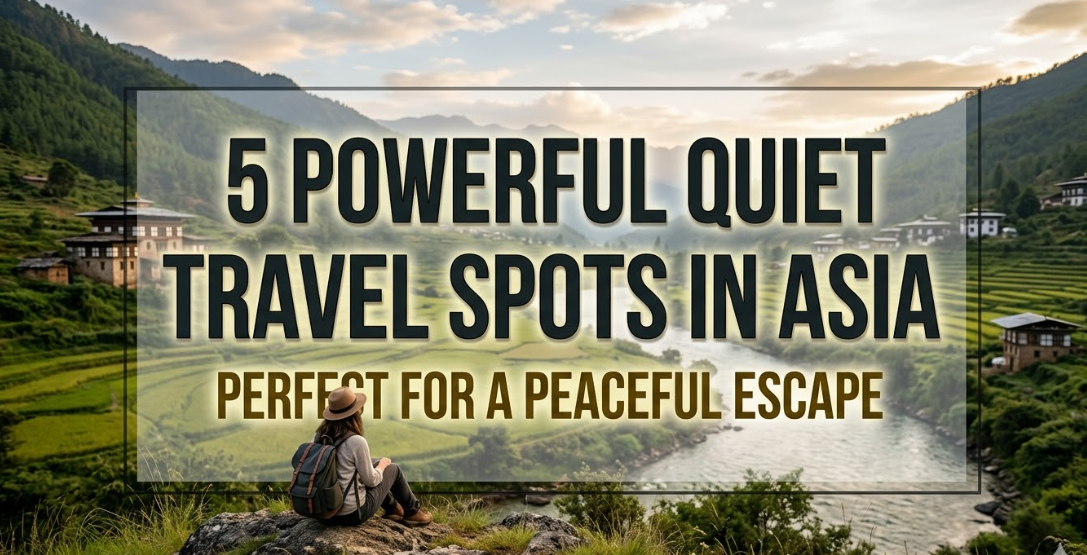
Bhutan itself is already quiet. The country limits tourism deliberately — visitors pay a Sustainable Development Fee ($100 per person per day), which keeps visitor numbers low and impact manageable. But even within Bhutan, Bumthang stands apart.
Bumthang is a cluster of four valleys in central Bhutan, sitting at around 8,700 feet. It is considered the spiritual heartland of the country. Some of Bhutan’s oldest temples, some dating to the 7th century, are here. The countryside is covered in pine forests, buckwheat fields, and apple orchards.
Of all the quiet travel spots in Asia on this list, Bumthang is the one where you genuinely feel the world has simply decided to leave you alone.
What Draws Travelers to Bumthang
Jambay Lhakhang. One of the first Buddhist temples built in Bhutan, founded in 659 AD. The temple is still an active place of worship. Butter lamps flicker inside. Monks chant. It feels alive in a way that many ancient sites do not.
Kurje Lhakhang. A complex of three temples built against a rock face where Guru Rinpoche — the saint who brought Buddhism to Bhutan — meditated in the 8th century. The walk through the surrounding fields is peaceful and beautiful.
The Bumthang Valley hike. A gentle trail leads from Jakar town through farmland, past traditional farmhouses, over a covered bridge, and up to a small monastery overlooking the valley. No crowds. No entrance fees. Just the sound of the wind and the bells.
The Red Panda Brewery. Yes, Bhutan has craft beer. Bumthang’s Swiss-style brewery, right beside a stream, produces surprisingly good ales using local ingredients. It’s quirky, warm, and very Bhutanese.
Bhutan’s Tourism Model and Why It Works
Bhutan’s “high value, low impact” tourism model has come under fire for its steep prices. And it is expensive — by backpacker standards. But that cost goes directly to funding education, healthcare, and conservation.
The result? A country that has preserved its culture, environment, and sense of self even as the rest of the world crowded out its neighbors. Walking through Bumthang, you genuinely feel that.
Bumthang at a Glance
| Detail | Info |
|---|---|
| Best time to visit | March to May, Sept to Nov |
| Ideal trip length | 5–8 days |
| Daily cost (SDF included) | $250–$350/day |
| Crowd level | Exceptionally low |
| Must-see | Jambay Lhakhang, Kurje Lhakhang |
| Getting there | Fly to Paro, then drive ~6 hrs |

How to Choose the Right Quiet Spot for You
Not every traveler is seeking the same type of peace. Here’s a quick guide to match your travel style with the right destination.
| Your Travel Style | Best Choice |
|---|---|
| Spiritual seeker | Bumthang, Bhutan |
| Nature and hiking lover | Yakushima, Japan or Spiti Valley, India |
| Budget slow traveler | Kampot, Cambodia |
| First-time Asia solo traveler | Luang Prabang, Laos |
| Extreme adventure & remoteness | Spiti Valley, India |
| Forest and wildlife lover | Yakushima, Japan |
| Cultural history buff | Luang Prabang or Bumthang |
Tips for Traveling Quietly in Asia
Here are some general tips that apply to all five destinations — and to quiet travel in Asia more broadly.
Travel in shoulder season. Even low-traffic destinations become more crowded during peak season. March, April, September, or October offers the best balance of weather and quiet.
Stay longer than you think you need to. The magic of slow travel destinations often doesn’t reveal itself until day three or four. One night is not enough to feel Luang Prabang. Three days is barely enough for Spiti.
Stay in locally owned guesthouses. They’re less expensive, more authentic, and your money stays in the community. In all five destinations on this list, local family guesthouses are available and recommended.
Learn a few words of the local language. Even “hello” and “thank you” in Lao, Hindi, Khmer, Japanese, or Dzongkha goes a very long way. It opens doors and eases the experience.
Leave the itinerary loose. The best moments in quiet places tend to be unplanned — a conversation with a monk, a path you stumbled on, a meal shared in someone’s kitchen. Give those moments space to happen.
FAQs About Quiet Travel Spots in Asia
Q: Are these quiet travel spots in Asia safe for solo travelers? Yes — all five destinations are considered safe for solo travelers, including solo women. That said, exercise normal caution, especially in remote areas like Spiti. Let someone know your plans when hiking alone.
Q: Which of these places is the most budget-friendly? Kampot, Cambodia is by far the most budget-friendly. You can travel comfortably for $25–$35 a day, including accommodation, food, and activities. Spiti and Luang Prabang are also reasonably priced. Yakushima and Bhutan are more expensive.
Q: Do I need a visa for these destinations? It varies by nationality. Laos, Cambodia, and Japan offer visa-on-arrival or e-visas for most Western passport holders. India requires a visa in advance. Bhutan requires a visa arranged through a licensed tour operator — it’s one of the details taken care of during booking.
Q: Which of these destinations is best for a one-week trip? Luang Prabang or Kampot can be done well in a week. Spiti and Bumthang benefit from longer stays because of the travel time getting there. Yakushima can be done in 4–5 days as part of a broader Japan trip.
Q: Can I visit multiple destinations on one trip? You could combine Kampot with a couple of days in Phnom Penh. Luang Prabang pairs well with northern Vietnam. However, Bhutan, Spiti, and Yakushima are very much standalone destinations — they require dedicated trips.
Q: What’s the best way to prepare for remote destinations like Spiti? Acclimatize gradually. Don’t rush up to altitude. Carry cash — ATMs are rare. Download offline maps (Maps.me or Google Maps offline). Pack layers, a good rain jacket, and a headlamp. And expect the unexpected.
Q: Are these places good for a digital detox? Absolutely. Spiti has very limited connectivity. Bumthang is patchy. Even Luang Prabang invites you to slow down. If disconnecting is your goal, these destinations will help you do it naturally — no apps required.
A Final Word: The Peace You’re Looking For Already Exists
There are plenty of peaceful places in the world. What it lacks is the desire to go after them.
These five quiet travel spots in Asia — Luang Prabang, Spiti Valley, Kampot, Yakushima, and Bumthang — are more than just lovely. They’re reminders. Reminders that travel doesn’t have to be exhausting. That the most glorious moments often come in slow minutes. That silence isn’t empty — it’s filled with things you can only hear when all else ceases.
You don’t need a packed itinerary. You don’t need the most-photographed spot on Instagram. You need a place that gives your mind room to breathe.
These five places will offer exactly that.
Happy slow traveling.